


Search the site

You Can Still Game AI Visibility. You Just Cannot Keep the Winnings
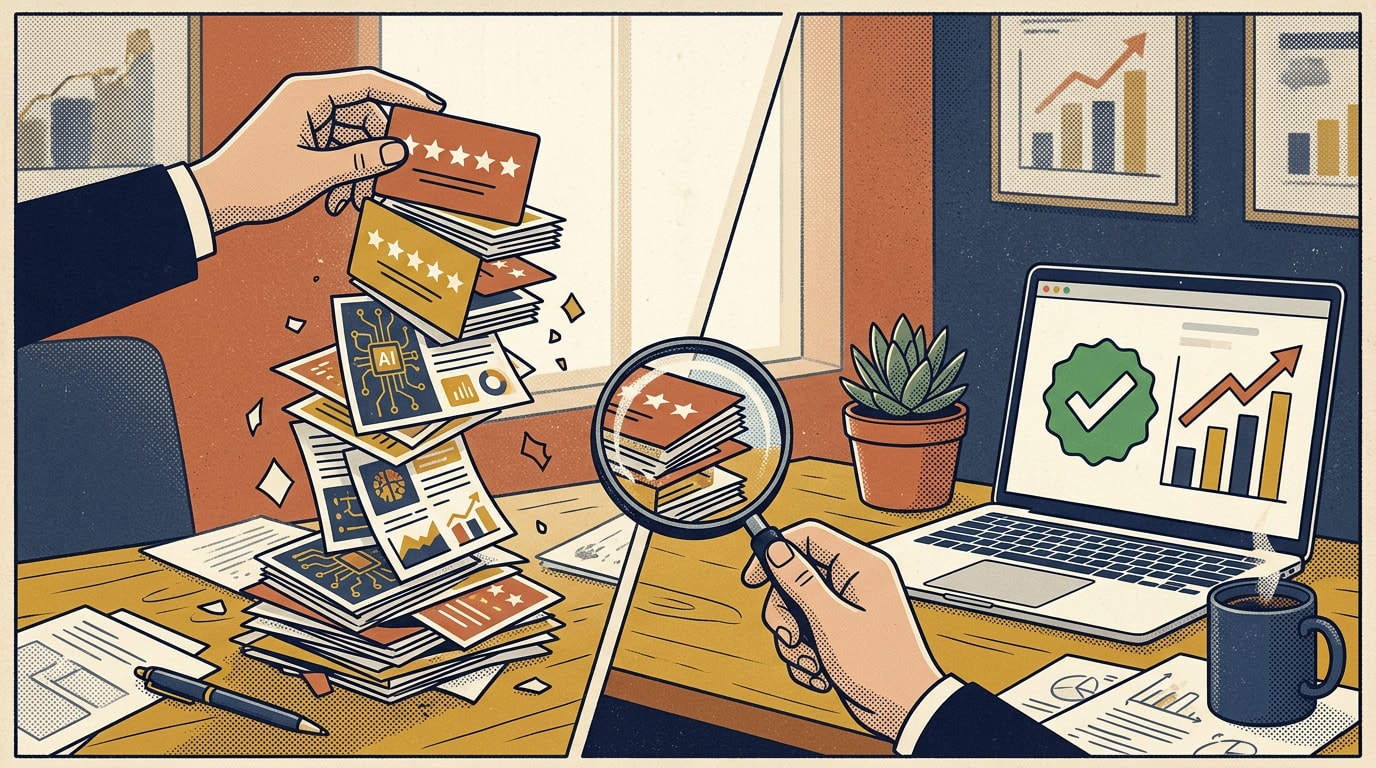
Can you game the visibility game today? Yes. Can you win? Also yes. Can you hold onto it? That is where the answer gets uncomfortable. Not long enough to book anything in Tahiti.
Gaming a system has always required a quiet agreement between three parties. The person doing the gaming, the system that allows it, and the person on the receiving end who never finds out. AI just broke that agreement in a way most marketers have not fully priced in yet. The ground is still bouncy. It is just getting harder every quarter.
I have been building and marketing companies in Pittsburgh for more than twenty years. I have watched three or four versions of this exact cycle. Something becomes cheap to fake, a wave of operators gets rich faking it, the market builds a detector, and the operators who never faked anything end up owning the category. What is different this time is the speed. The detector arrived roughly eighteen months after the fake, not eighteen years.
Every Scam in History Ran on One Assumption
The assumption is that verifying is expensive and believing is cheap.
The snake oil salesman rolled into town before anyone could compare notes with the next village. The dropshipper bought four hundred five-star reviews before customers caught on. Same trade, different century. If it costs a buyer more effort to check you than to just believe you, the liar carries a structural advantage.
AI changed that equation on both sides at once, and only one side gets discussed at conferences.
Everyone talks about the first side. AI made it absurdly cheap to produce good-enough output. Testimonials that read like real people. Cold emails that reference your funding round. An ebook called The Ultimate Guide To Literally Anything, written between lunch and a 2pm standup.
The second side gets almost no airtime. AI also made verification nearly free. Your buyer can now ask a model where your statistic came from, who published the framework first, whether the reviews on your G2 profile pattern-match to incentivized reviews, and what actual users complain about on Reddit. That used to be a research project. Now it is four prompts and a coffee.
I do not think AI is ushering in an era where nonsense wins. I think it is ushering in an era where nonsense becomes inflationary. The more of it we produce, the less any single unit of it is worth. The only asset appreciating is the one that cannot be manufactured on demand, which is trust.
The Verification Cost Test
This is the frame I now use with every brand we work with, and it takes about ninety seconds to run on any marketing tactic you are considering.
Ask two questions. How expensive is this to fake? How expensive is this to check? Then find where your tactic lands on the grid.
| Signal | Cost to fake | Cost to verify | Practical half-life |
|---|---|---|---|
| Bought reviews | Very low | Very low and dropping | Months. Platform detection plus federal rules now both bite. |
| High-volume AI content | Very low | Low | Quarters. It ranks until the category saturates, then everyone is invisible together. |
| Undisclosed affiliate listicles | Low | Low | Quarters. One informed reader with a chat window unwinds the whole thing. |
| AI-personalized cold outreach | Very low | Free, because everyone gets the same email | Already expired. The medium itself lost credibility. |
| Original testing and benchmark data | Very high | Easy, and checking confirms you | Years. Verification makes it stronger, not weaker. |
| Named customers with real outcomes | Effectively impossible | One phone call | Years. This is the only durable moat on the list. |
Notice the pattern in the bottom two rows. When something is genuinely true, cheap verification is not a threat. It is free distribution. That inversion is the whole story of the next five years in marketing.

Start With Reviews, Because That Is Where the Money Was
Reviews were the most profitable thing to fake because they sit closest to the purchase decision, and because for a long time nobody was actually checking.
According to BrightLocal's 2026 Local Consumer Review Survey, 97% of US consumers still read reviews when evaluating a business, and the share who say they always read them jumped from 29% to 41% in a single year. Reviews did not lose influence. They gained it.
So the incentive is obvious. Spend a few hundred dollars, lift your star rating, convert more customers. If you were running a mediocre restaurant, a shaky SaaS product, or a store selling a posture corrector that looks like two backpack straps stitched together, buying reviews was one of the highest-ROI line items available.
Then two things happened at once. Consumers got suspicious, and the enforcement got real.
The FTC's Rule on the Use of Consumer Reviews and Testimonials took effect in October 2024, and in December 2025 the agency sent warning letters to ten companies over possible violations. Civil penalties run up to $53,088 per violation, and enforcement practice has generally treated each individual fake review as its own violation.
Do that math on a package of fifty purchased reviews. It is not a marketing expense anymore. It is an unfunded liability sitting on your balance sheet.
Meanwhile the platforms scaled up their own defenses hard.
In 2025 alone, Google reported blocking or removing more than 292 million policy-violating reviews, pulling down over 13 million fake Business Profiles, and putting posting restrictions on more than 782,000 accounts. That is not a filter. That is an immune system.
And here is the part that should actually worry you. Consumers are not just aware of fake reviews. They want blood. BrightLocal found that 93% of consumers think somebody should be responsible for catching fake reviews, and the overwhelming majority believe businesses caught using them deserve real consequences.

If you are trying to build a defensible review profile the honest way, that is a whole operational discipline in itself, and it is worth reading through our breakdown of the best online reputation management software for real-time visibility and response before you pick a stack.
Reviews are now a compliance surface, not just a marketing surface. If you are a multi-location brand, the person who owns your review generation program should be able to explain your process to a regulator without flinching. If they cannot, you do not have a growth channel. You have exposure.
AI Turned Average Into a Commodity
There was a stretch, not that long ago, where publishing volume was a moat. Companies hired armies of freelancers to cover every keyword in the category. Entire businesses were built on producing good-enough content slightly faster than the next guy.
Today anyone can generate a hundred articles before dinner. Unfortunately, so can everyone else. The easier something is to produce, the less advantage producing it creates. That is not a moral position. That is just supply and demand.
The data on this is more interesting than the doomsaying suggests.
Even though more AI-generated articles are now published on the web than human-written ones, Graphite found that 86% of articles ranking in Google Search are human-written, and 82% of articles cited by ChatGPT and Perplexity are human-written. The flood is real. The flood is also mostly invisible.
Sit with that gap. More than half of new articles are machine-generated, and yet the overwhelming majority of what gets ranked and cited is not. The market is producing enormous quantities of content that nobody reads, nothing links to, and no model bothers to cite. It is the marketing equivalent of printing money in a currency nobody accepts.
Let me make it concrete. Say someone is researching project management software. One site gives them a tidy AI-generated list called The 25 Best Project Management Tools for 2026. Another publishes six months of benchmark data across every platform, with screenshots, migration stories, pricing experiments, and quotes from customers who actually switched.
Both might rank. Only one gets trusted. And only one gets cited when a model needs a defensible source for a specific claim.
This is why AI crawlers will happily reach the fiftieth result. When the top ten are interchangeable summaries of each other, position fifty with original data is genuinely more useful than position three with none. Depth is now a retrieval strategy, not just a brand strategy.
There is an even weirder second-order effect showing up in the research. In June 2026, Axios covered a Graphite paper describing what they call AI search collapse, where models retrieving AI-generated pages that were themselves derived from earlier AI answers start converging on the same narrow set of recommendations. The web starts eating its own homework.
Which means original, verifiable, primary information is not just a differentiator for buyers. It is becoming a scarce input for the machines too.
The Listicle Had a Good Run
Around May 2026 a wave of research came out celebrating listicles and how much AI models love them. The industry, already jittery, went into overdrive. And as with every frenzy, the operating question quietly shifted from how do I help this reader choose well to how do I get there first.
Not all of it is cynical. Some of those rankings represent months of genuine testing. Others represent opening the first five Google results, reordering them, swapping a few adjectives, adding affiliate links, declaring nothing, and hoping the commissions cleared before anyone looked closely.
For years consumers tolerated this because they had no practical alternative. Testing twenty CRMs yourself is not how anyone wants to spend a weekend.
Now watch the new sequence. Someone asks ChatGPT to compare ten CRMs. Then they ask Claude which of those reviews look sponsored. Then they open Reddit to see what real users complain about after month four. Total time, maybe eleven minutes.
The well-researched listicle survives that sequence just fine. The lazy one does not. And once you become known as the person who publishes the lazy version, you have converted a short-term ranking into a long-term reputation problem. You got the position. You spent the trust.
If you are going to build a listicle, build one that gets better under scrutiny. That means declared methodology, declared affiliate relationships, real drawbacks for every tool including the ones you like, and at least one thing in it that nobody else has. We write about this a lot in our SEO and AEO coverage, and it is the single most common gap we find when we audit a competitor's top-ranking page.
AI Makes Expertise Look Cheap, Which Makes Proof Expensive
One of AI's real talents is confident nonsense. Ask it almost anything and you will get something that sounds authoritative. Which is why LinkedIn is now populated by thousands of strategists who developed profound views on agentic AI roughly twelve minutes after learning the phrase.
Confidence has never been cheaper to manufacture. Which means proof has never been more valuable.
Your reader does not have to accept your statistic anymore. They can ask where it came from. They do not have to trust your framework. They can ask who published it first. They do not have to believe your product claims. They can compare four hundred reviews in a single query.
Anyone can sound smart on a given Tuesday. The people who win are the ones who are still right in six months, when the thing they predicted either happened or did not. That is a much harder game, and almost nobody is playing it, which is exactly why it is worth playing.
This is also the practical core of answer engine optimization. Models are increasingly resolving questions about who is credible in a category, and the inputs to that judgment are things you cannot fake at scale. We dug into how that plays out on the reputation side in our piece on how reputation management is changing the way we trust AI answers.
Personalized Spam Is Still Spam
Email personalization worked because it was hard. Someone noticed your funding round, mentioned your podcast, referenced a feature request you tweeted three weeks earlier. That attention was rare, and rare things carry signal.
Today an agent does all of that for ten thousand prospects before lunch.
Personalization became another casualty of abundance. Recipients now assume the thoughtful opening paragraph was generated, because it usually was. Classic tragedy of the commons. Every individual sender gains from personalizing more. Collectively they destroyed the credibility of personalization itself.
The Instantly 2026 Cold Email Benchmark Report, built on billions of interactions across more than 700,000 businesses, puts the average reply rate at 3.43%, down from 5.1% the year prior. Meanwhile campaigns sent to 50 recipients or fewer average 5.8% replies versus 2.1% for lists of 500 and up. Smaller and more specific still beats bigger and faster.
Read those two numbers together and the strategy writes itself. The channel did not die. The volume approach died. Sending fewer, better, genuinely researched emails now outperforms sending more of them, which is the opposite of what the tooling is optimized to encourage you to do.
Where Teams Get This Wrong
I want to be specific here, because the abstract version of this argument is easy to nod at and impossible to act on.
Treating AI as a content multiplier instead of a research multiplier
Most teams point AI at the output. Point it at the input instead. Use it to synthesize two hundred support tickets, to cluster complaints across competitor review profiles, to pull patterns out of your own sales call transcripts. That produces things nobody else has. Using it to write the draft produces things everybody has.
Measuring the channel instead of the belief
Rankings, impressions, and citation counts are downstream of whether a buyer believes you. If your dashboard has no metric that tracks belief, you will keep optimizing the proxy long after it stops correlating with the thing. Branded search volume, direct traffic, and repeat visitors are cruder but far more honest. If you want to see this exact gap play out in real 2026 research, I broke down the data in You Can Keep the Audience and Still Lose the Click, where Google's audience number holds steady while queries and clicks quietly decline underneath it.
Publishing claims you cannot survive being checked on
Every unsourced statistic in your content is a small unsecured loan against your credibility. It works fine until one reader pulls the thread. Cite primary sources, link them on the keyword, and when you do not have data, say you do not have data and give your reasoning instead. Reasoning is checkable in a way that fake precision is not.
Assuming the arbitrage window is longer than it is
Teams see a tactic working, extrapolate eighteen months of returns, and build headcount around it. Almost every current AI-visibility arbitrage has a shelf life measured in quarters. Run the tactic if you want, but do not fund a department on it, and do not let it crowd out the slow work that compounds.
What Actually Compounds
Here is the short list of things I would put budget behind right now, in rough order of how confident I am that they will still be working in three years.
| Investment | Time to payoff | Why it survives cheap verification |
|---|---|---|
| Original data you collect yourself | 3 to 6 months | It cannot be regenerated by a competitor's prompt, and it becomes the thing others have to cite. |
| Named customers with specific outcomes | Ongoing | Verifiable in one phone call, and the verification is the sale. |
| Public, dated predictions | 12 to 24 months | Being right on the record is the only credential AI cannot fabricate for someone else. |
| Genuine drawbacks in your own content | Immediate | Admitting what you are bad at is the cheapest trust signal available, and almost nobody uses it. |
| A clean, consistent, machine-readable site | 1 to 3 months | Agents resolve conflicting information by discarding you. Consistency is now a ranking input. |
| Review programs built to be audited | 6 to 12 months | Survives both platform enforcement and a regulator reading your process. |
None of these are fast. That is the point. If it were fast, it would be cheap to fake, and if it were cheap to fake, it would already be worthless.

The brands winning AI visibility right now are not the ones with the best prompt engineering. They are the ones with something true to say that nobody else can say, published in a format machines can parse. Everything else is a rented position. If you want help figuring out which of these actually apply to your business, that conversation is always free at Aiken House.
One Last Thing
Fake reviews, disposable AI content, lazy affiliate listicles, and machine-personalized outreach all look like separate stories. They are the same bird.
What we are watching is the collapse of an economic model that ran on manufactured credibility. The exact same systems that made it trivial to generate convincing fiction also made it trivial to compare, verify, investigate, and expose it. Both curves moved. Everyone only priced in one of them.
The uncomfortable part is that a lot of us are not in the audience watching this happen. We are standing on the stage. And whoever set the stage never mentioned that it was built across the tracks, or that the five o'clock freight runs on time.
If you want a sober read on which of your current tactics have a shelf life and which ones are actually compounding, we do that work every week. Start with our AI and content strategy services or just reach out directly. No deck, no discovery theater.
Data sources: BrightLocal Local Consumer Review Survey 2026 (1,002 US adults); US Federal Trade Commission, Rule on the Use of Consumer Reviews and Testimonials; Google, New ways we are protecting businesses on Maps (April 2026); Graphite, AI Content in Search and LLMs; Axios coverage of Graphite AI search collapse research (June 2026); Instantly 2026 Cold Email Benchmark Report.
Related ...




Subscribe to our insights


