


Search the site

What Makes a Quality Blog Post
Half the articles published on the internet last quarter were written by a machine. Almost none of them will ever be read.
That is not a moral judgment. It is a traffic report. Graphite tracked English-language publishing across five quarters and found that AI-generated articles now make up roughly half of everything published, hovering right around the 50% line since early 2025. Meanwhile Ahrefs studied about 14 billion pages and found that 96.55% of them get zero traffic from Google.
So the supply of content went vertical and the demand did not. Which means the bar for what counts as a quality blog post moved, and most teams are still writing to the old one.
Here is the short version of the new bar. A quality blog post in 2026 is one that could not have been written by someone who only read page one of Google. It clears three tests. It covers what the top results cover in fewer words. It adds first-hand information that does not exist anywhere else on the web. And it is structured so a language model can lift a clean answer out of it. Everything else, the word count and the header tags and the image alt text, is execution detail.
Below is the standard our writers work from, with a rendered example of every rule so nobody has to guess what it looks like in practice.
Nobody is grading you on effort anymore
The old content playbook assumed scarcity. Write a decent 1,500-word post on a keyword nobody had covered well, earn a few links, rank. That worked because writing was expensive.
Writing is not expensive now. Ahrefs ran 900,000 newly published pages through their detector and found that 74.2% contained at least some AI-generated content, with only about a quarter reading as purely human. Every competitor in your category can now produce a competent 2,000-word article on any topic in about nine minutes.
Competent is the problem. When everyone can hit competent, competent is the floor, and the floor does not rank.
Only 1.74% of newly published pages crack the top 10 for even one keyword within a year of going live. Publishing is not a strategy. It is a lottery ticket you buy with your team's time.
Where your reader actually is right now
The assumption I hear most often is that professionals have quietly switched to ChatGPT and everyone else is still on Google. Both halves of that are wrong.
Nobody has left Google. Ahrefs put ChatGPT at roughly 12% of Google's search-like query volume, and Google still sends about 190 times more traffic to websites. If you are choosing one surface to optimize for, it is still Google, and it is not close.
What actually changed is quieter and worse for publishers. People are not searching somewhere else. They are searching less, because each search now answers more.
Datos and SparkToro found that Google searches per US user fell about 20% year over year, while total Google volume kept growing. The pie did not shrink. The slice you used to win is getting eaten before it ever leaves the results page.
The clicks tell the same story, only louder.
In the first four months of 2026, 68.01% of US Google searches ended without a single click. In 2024 it was 60.45%. SparkToro calls it the fastest acceleration in the decade they have been measuring it.
45%
49%
60%
68%
Share of US Google searches ending with no click. Sources: SparkToro with Jumpshot, Datos, and Similarweb.
And the year-over-year number is worse than the two-year one. Ahrefs runs a public tracker across more than 75,000 opted-in domains. Between June 2025 and May 2026, Google's share of the traffic it sends those sites fell eight percentage points, roughly a 22% drop in a single year. Rand Fishkin's note on that panel is the part that should worry you: these are sites with professional marketers actively working to grow traffic. That is the group losing 22%.
Two mechanisms are doing most of the work. AI Overviews now appear on more than 20% of all Google searches, and when one is present, click-through rate drops by nearly 60%. The rest is Google getting better at convincing you to run another search instead of leaving.
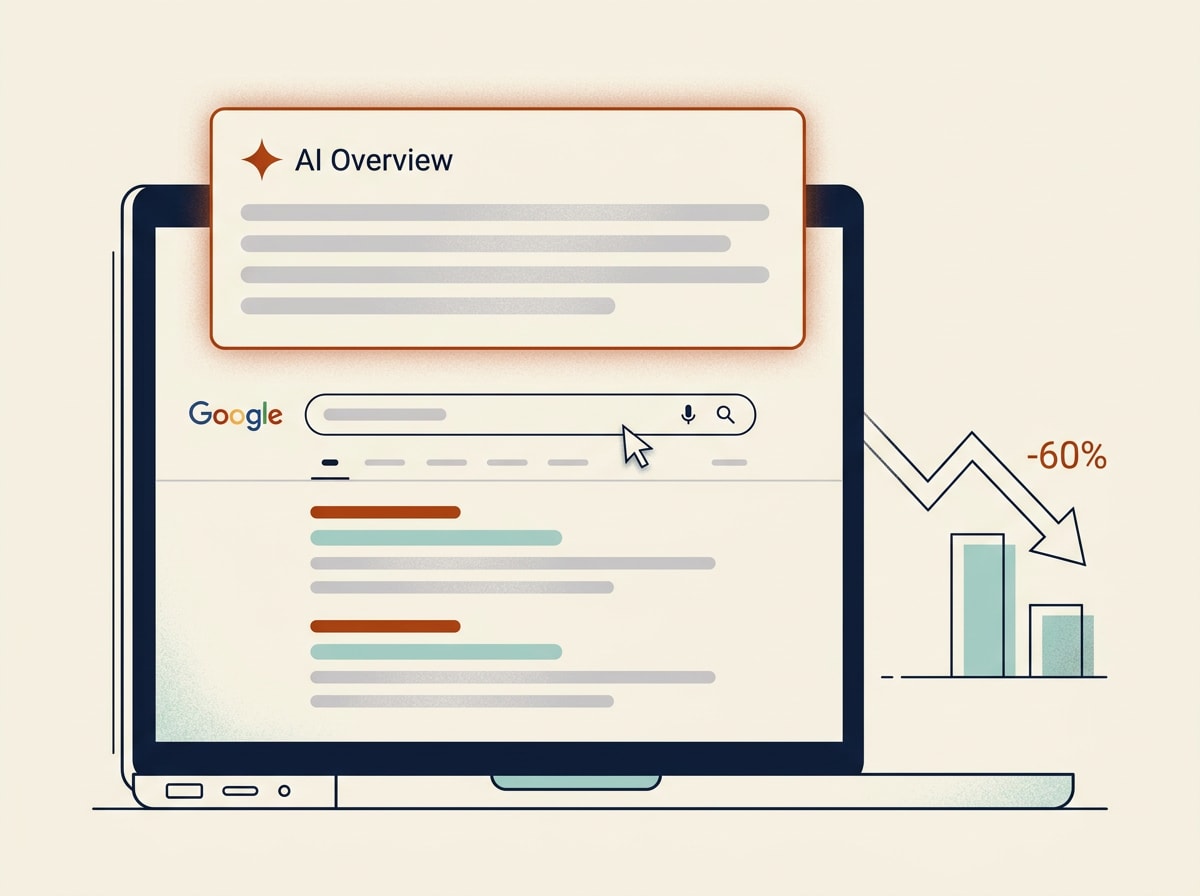
The practical consequence for anyone publishing: ranking and getting traffic have come apart. You can hold position three and watch sessions fall every quarter without doing anything wrong. Which means the point of a post is no longer only the click. It is the mention, the citation, and the brand impression that happens whether or not anyone lands on your site.
And the mainstream adoption question has an answer now. Pew surveyed 5,119 US adults in February 2026 and found that half the country is already here.
That second column is the part people miss. This is not a developer and consultant phenomenon anymore. It is gift research, weekend plans, comparison shopping, and figuring out what to do about a leaking dishwasher.
Adobe tracks over a trillion visits to US retail sites. In Q1 2026, traffic to retailers from AI sources grew 393% year over year. The bigger reversal is quality: in March 2025 that traffic converted 38% worse than everything else. By March 2026 it converted 42% better.
Small share of visits, disproportionate share of buyers. Those people arrive having already narrowed the field inside a chat window, which means the decision got made somewhere you cannot see and cannot bid on. You either got mentioned in that conversation or you never entered it.
So the honest read is not "optimize for AI instead." It is that one piece of content now has to work on two surfaces at once, for an audience that is no longer niche. Which is the whole reason step one has two halves.
Step one: audit the SERP and the LLMs before you write a word
This is the step everybody skips, and it is the one that decides whether the post was worth writing.
Start with the search results page itself, before you open a single competitor. Screenshot the whole thing. What you are looking for is not the ten blue links, it is everything wrapped around them: whether an AI Overview sits on top and eats the clicks, which questions show up in People Also Ask, who owns the featured snippet, and whether Reddit, YouTube, or a forum thread is outranking every blog on the page.
That layout is Google telling you what it thinks the query wants. If the whole page is video and forum threads, a 2,000-word article is the wrong shape of answer no matter how good it is. And the People Also Ask box is a free FAQ block, written in the exact words real people use.

How often should I publish?
Does AI content rank on Google?
2. Agency guide · listicle
3. reddit.com/r/Blogging
4. YouTube · 11 min
5. Agency guide · listicle
Then read the top five ranking results in full. Not the meta descriptions. Not the H2s. The whole page. You cannot beat something you have not read, and most "competitive research" is just skimming headlines and calling it a day.
Then do the part almost nobody does. Run the exact target query through ChatGPT, Claude, Perplexity, and Google AI Mode. Write down the answer each one gives and every source each one cites. That takes about ten minutes and it tells you two things the SERP will not: what the models currently believe about your topic, and which sites they trust enough to quote.
Those cited sites are often not the ones that rank. Surfer's analysis of AI Overviews found that 67.82% of cited sources do not rank in Google's top 10 for the same query. If you are only studying the SERP, you are studying half the board. We went deeper on that split in our piece on how Google, Perplexity, and ChatGPT each shape what people find.
Now build a gap list with three columns.
If the gap column comes back empty, do not write the post. Pick a different angle or a different keyword. A tenth version of an article that already exists nine times is not content marketing. It is throwing time into a hole.
Step two: originality is the whole job now
Here is the number that reorganized how we write.
An Ahrefs analysis of ChatGPT's 1,000 most-cited pages found that 67% of them come from original research, first-hand data, or academic sources. Not synthesis. Not roundups. Sources that know something the rest of the web does not.
That makes sense once you think about what a model is doing. It has already read every generic explanation of your topic ten thousand times. It does not need an eleven thousandth. What it cannot generate on its own is what actually happened when a specific person ran a specific thing in the real world.
So the standard is simple to state and hard to hit. Every post needs information that is not on the web yet.

What counts as original: screenshots from your own accounts, a client result with the real number and timeline, an internal benchmark from your own book of business, a small audit of even 20 sites, something a vendor rep told you on a call that is not in their docs, or the version that broke and what it cost before it worked.
What does not count: rewording someone else's article, a better-organized summary of the same five sources, or an opinion with no evidence under it. Original data beats original opinion, and both beat original phrasing.
Byline matters too. Who is talking is part of the evidence — a real name and a real bio beats "Admin, Posted in Marketing" every time.
That is also why LinkedIn has quietly become an LLM input worth optimizing. The author profile is part of the ranking surface now.
Step three: format it so a machine can lift it
You can have the best original data in your category and still get skipped if the post buries it in paragraph 14.
Answer the question in your title inside the first 100 words, in one clean self-contained paragraph. Not a teaser. Not "we'll get to that below." The actual answer, written so it survives being copied out of context.
Then match the format to the content. Numbered lists for processes. Tables for comparisons. Bullets for attributes. Same information, wildly different odds of getting pulled into an answer.
Tool A starts at $49 per month and includes prompt tracking, while Tool B is $129 monthly with prompt tracking and citation history, and Tool C runs $400 a month but adds competitor share of voice.
| Tool | Price | Key feature |
|---|---|---|
| Tool A | $49/mo | Prompt tracking |
| Tool B | $129/mo | Citation history |
| Tool C | $400/mo | Share of voice |
And state facts plainly. "This tool costs $49 per month" gets quoted. "This tool is affordably priced" gets ignored, because it says nothing a model can stand behind.
None of this is new if you have been following why GEO stopped being a trend and became the default. It is just the part of it that lives inside a single blog post.
AI citations are less durable than rankings. One longitudinal audit tracked 1,127 cited URLs across six weeks and found only about 10.6% still appearing in all three waves. Getting cited once is not a moat. It is a checkpoint you have to keep passing.
Step four: the craft that decides whether anyone finishes
Models decide whether you get quoted. Humans decide whether you get remembered, and they bounce faster than any algorithm.
Start with the opening. Never a definition.
Then the subheads. Write them as promises, not labels.
Content Strategy
Conclusion
The three posts worth writing this quarter
The only test that matters
Paragraph length is the rule people underrate. One to three sentences. You can see the difference without reading a word of it.
Then the kill list. These words are the fingerprint of a draft nobody edited.
After: "This framework works. Here is what it did for us."
No em dashes either. That one is personal preference, but it also happens to be the most reliable tell that nobody touched the draft after the model wrote it.
Last check before publishing: read the whole thing out loud. Anywhere you stumble, the reader leaves.
Step five: no stock photos, ever
Somewhere along the way "add images to your blog post" became "drop in a photo of four people in a glass conference room high-fiving over a laptop." That image has appeared on nine million pages. It carries no information. It tells the reader that whoever made this post got to the image step, sighed, and searched Unsplash for "teamwork."
The rule is simple. Every visual has to carry information the prose cannot. If you could delete it and the reader loses nothing, delete it.
Volume does help, but only when the visuals are real. Siege Media cites Semrush research showing articles with more than seven images earn substantially more organic traffic than articles with none. That is not an argument for seven stock photos. It is an argument for building seven things worth looking at.
Here are the four types that consistently earn their pixels.
1. A chart built from numbers you gathered
This is the highest-leverage visual you can make, because it does two jobs at once. It breaks up the text, and it is the original data your post needed anyway.
2. Your own screenshot, annotated
A raw dashboard screenshot is decoration. The annotation is the whole value. Circle the number, add a caption that says why it matters, and now the image is making an argument instead of filling space.
high-fiving over a laptop
3. A diagram of the thing you are explaining
If you are describing a process, a framework, or a decision, draw it. The gap board earlier in this post is a diagram. So is the SERP breakdown. Neither one is art, and both of them do work that three paragraphs of prose would do worse.
Stat cards count here too. Three numbers, big type, one line of context each. It takes ten minutes and it gives the skimmer somewhere to land.
4. Something with a joke in it
An original illustration or an AI-generated meme beats a stock photo every time, on one condition: there has to be an idea in it. A generated image of a robot at a laptop is just a stock photo with extra steps. A generated image that makes an argument is a visual.
Two rules if you go this route. Generate your own image instead of pasting a copyrighted meme template, and never use a generated image for anything factual. Illustration and jokes are fair game. A fabricated chart or a fake screenshot is not.
Write alt text that describes the information, not the object. "Chart showing 96.55% of pages get no Google traffic" is useful to a screen reader and to a model parsing your page. "Bar chart" is useful to nobody.
Step six: one great post does not get cited, a cluster does
This is the rule that separates blogs that compound from blogs that just accumulate.
Both Google and the language models are asking a question about your site that has nothing to do with the post in front of them. Does this domain actually know this subject, or did it wander in once? The HOTH's engine-by-engine analysis puts it plainly: AI tools cite sources that show consistent, validated expertise across a topic, not one-off pages. Pillar and cluster coverage is what earns that status.

Which means internal links are not plumbing. They are the mechanism by which a page inherits authority from everything else you have published, and the mechanism by which a model figures out what you are the expert in.
Three rules follow from that.
Every internal link should sit inside the same topic cluster. Four links to genuinely related posts beat ten links scattered across unrelated categories. A link from your content standards post to a post about HR software is not a link, it is noise, and it tells a model your site is about nothing in particular.
The page doing the linking has to have authority of its own. This is the part almost everyone misses. A link from a thin, unlinked, uncited post passes along roughly nothing. Before you drop an internal link, ask whether that source page is any good. If it is not, the honest fix is to improve that post, not to link from it.
Link in both directions on publish day. A new post starts with zero internal authority. Go back into the three strongest older posts on the subject and link them forward to the new one. That takes fifteen minutes and it is the difference between a post that sits alone and a post that is wired into everything you have already earned.
And the anchor text still matters. It should describe the destination and make sense read out of context, because that string is one of the strongest signals a model gets about what the linked page is about. "Learn more" tells it nothing.
Last thing: at least one link per post should point at a page that makes money. Traffic that never reaches a service or product page is a vanity metric with a nice chart attached.
The old bar versus the current one
| What most teams still do | What actually clears the bar |
|---|---|
| Skim competitor headlines | Audit the full SERP, read the top five, log four LLM answers |
| Cover the topic thoroughly | Cover the consensus fast, spend the post on the gap |
| Cite published studies | Cite published studies and add your own data |
| Optimize the H1 and meta | Write one liftable answer paragraph up top |
| Add seven stock photos | Build seven things worth looking at |
| Sprinkle in internal links wherever they fit | Wire the post into a cluster, both directions, on day one |
| Publish on schedule | Kill the post if the gap list is empty |
The one-page standard
Everything above lives on a single page our writers keep open while they work.
☐ Top 5 Google results read in full
☐ Query run through 4 LLMs, sources logged
☐ Gap list built before drafting
☐ First-hand experience in the post
☐ Original data or result included
☐ Named author with a real bio
☐ At least one comparison table
☐ FAQ block at the bottom
☐ 4 to 6 internal links, same topic cluster
☐ 3 older posts linked forward to this one
☐ At least one link to a money page
☐ Every stat linked to its source
☐ Zero stock photos, visuals carry info
☐ Kill list clean, zero em dashes
☐ Read out loud, start to finish
FAQ
What is the zero-click rate in 2026?
68.01% of US Google searches ended without a click in the first four months of 2026, according to SparkToro using Similarweb clickstream data. That is up from 60.45% in 2024 and roughly 45% a decade ago. On Ahrefs' 75,000-domain tracker, Google's referred traffic share fell about 22% between June 2025 and May 2026.
Have people actually stopped using Google?
No. Google still handles roughly eight times the search-like query volume of ChatGPT and sends about 190 times more traffic to websites. What changed is that Google searches per US user dropped around 20% year over year, because AI summaries answer more per search. Total volume grew while your slice of it shrank. Optimize for both surfaces, and do not let anyone talk you into abandoning the one that still pays.
How long should a blog post be in 2026?
Around 2,000 words for most commercial topics. Length is a byproduct, not a target. The right length is however long it takes to be the most complete answer with nothing padded in, which for most keywords lands near 2,000.
Does Google penalize AI-generated content?
No, and that is the wrong question. Google's stated position is that it rewards helpful content regardless of how it was produced. The practical problem is that AI drafts default to synthesizing what already exists, and synthesis of existing material is exactly what does not rank or get cited. Use AI to draft faster, not to think less.
How do I get my blog cited by ChatGPT and Perplexity?
Publish something the model cannot produce on its own. Original data, first-hand results, and clearly attributable facts, formatted into liftable units near the top of the page. Then track it, because citations decay. Our breakdown of the AI visibility tracking stack covers the tooling side.
What if I do not have original data to share?
You have more than you think. A 20-site audit, a screenshot of your own account, a summary of what ten sales calls taught you this quarter. Original does not mean a research budget. It means it did not exist on the web before you published it.
The only test that matters
Would a smart person in your target audience forward this post to a colleague?
If the honest answer is no, the post is not finished. It is just long. And long is the one thing the internet has plenty of.
If you want help building a content operation that clears this bar instead of filling a calendar, come talk to us. We also keep a running list of the content marketing agencies worth knowing in 2026 if you would rather shop around first.
Joey Rahimi is the founder of Aiken House, a venture studio in Pittsburgh. He has spent the last two years rebuilding content programs around AI search for brands across e-commerce, travel, and fintech.
Related ...






Subscribe to our insights


