


Search the site

GEO Is Not a Trend. It's the New Default for Anyone Who Wants to Be Found Online

I want to be upfront: I spent a long time being skeptical about Generative Engine Optimization. The term felt like consultants rebranding the same work they'd always done, slapping "AI" on it, and charging more. Then I sat with the actual numbers. And then I had a few conversations with people building and running content inside some of the largest digital platforms on the planet. That skepticism didn't survive those conversations.
Here's what changed my mind: Google's AI Overviews now reach billions of users every month. Not thousands. Not millions. Billions. And when someone gets an AI-generated answer to their question, they often don't scroll past it. That is not just a hunch anymore, it is measurable: a preregistered field experiment found an 18.8 percentage point drop in clicks to external sites once AI Mode took over the search results page, the exact pattern I dig into in You Can Keep the Audience and Still Lose the Click. The link below that answer, the one your SEO team has been working to secure for the past three years, might not get clicked at all.
That's the shift. Visibility used to mean ranking on page one. Now it means being in the answer itself. And if you're not actively thinking about that, you are already behind.
ChatGPT hit 100 million users faster than any application in internet history, surpassing the growth rate of both TikTok and Instagram at their peaks. The speed at which AI search tools became mainstream is not just a tech story. It's a customer acquisition story.
What GEO Actually Is (Without the Jargon)
Generative Engine Optimization is the practice of making sure your brand, your content, and your products appear inside the responses generated by AI-powered search tools. That means platforms like ChatGPT, Perplexity, Google's AI Overviews, and others that synthesize information from across the web before handing a user an answer.
The traditional game was: get a user to type a query, get your page to rank high enough that they click your link. GEO changes that game. Now, the AI reads your page, reads fifty other pages, synthesizes everything, and gives the user a single answer. If your content is part of what the AI pulls from, you get a citation. You get visibility. If it's not, you're invisible.
Someone I spoke with who works deep inside content strategy at a major publishing platform put it bluntly: "We stopped thinking about getting clicks. We started thinking about whether the answer the AI gives includes us. If it doesn't, we don't exist for that user."
"The goal isn't to rank anymore. The goal is to be part of the answer. Those are two completely different optimization problems." A content strategist at a top-tier digital media company
GEO also covers what some people call agentic search: cases where the AI doesn't just answer a question but actually performs a task. That could mean comparing products, booking a service, or making a purchase on behalf of a user. If you're in e-commerce and your products aren't surfaced by these agents, you're missing transactions that happen without your site ever loading.
How AI Search Actually Works (The Part That Matters for Your Strategy)
Before we get into what to do, you need to understand how AI systems retrieve and use information. This isn't a technical deep-dive. It's what you need to know to make good decisions about your content. And if you want a closer look at how each platform behaves differently, we broke that down in detail in our piece on how Google, Perplexity, and ChatGPT each shape your online reputation.
AI language models are trained on enormous amounts of text from the internet. That training gives them general knowledge. But when you ask a tool like Perplexity a question today, it also does a live web crawl. It fetches current pages, reads them, and synthesizes them into a response. The pages it crawls, the way it reads them, and how it weighs their credibility all affect whether your content gets cited.
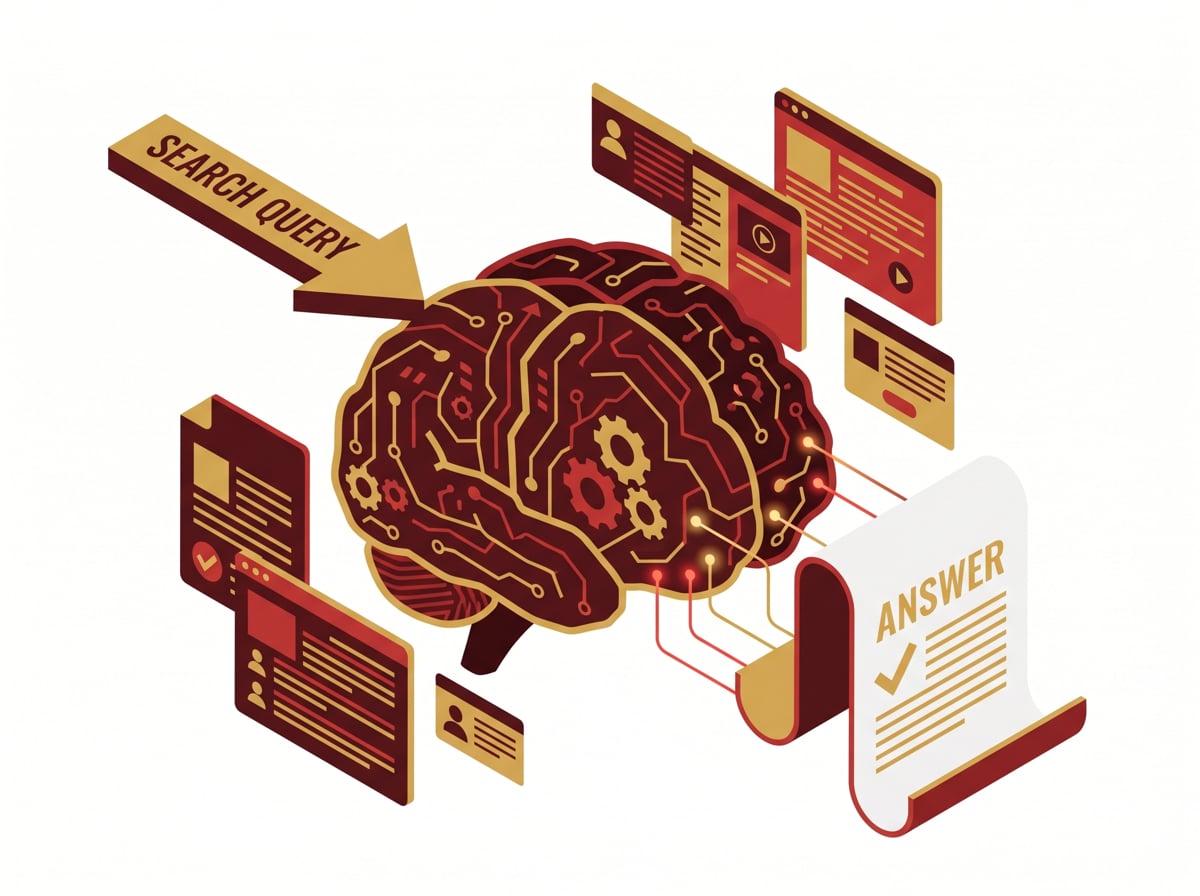
A query enters the machine, dozens of sources get read and weighed, one synthesized answer comes out. Your content either makes it into that answer or it doesn't.
Here's what many marketers miss: the AI doesn't care about your meta title or your keyword density in the way a traditional crawler does. It's reading your actual content. It's evaluating clarity. It's checking whether your page answers a real question. It's looking at whether other credible sites mention you. That shift in how content gets evaluated is what makes GEO feel different from SEO, even if many of the underlying tactics overlap.
SEO vs. GEO: The Comparison You Actually Need
I want to address the framing war that's happening in marketing circles right now. Some people are saying GEO is just rebranded SEO. Others are saying SEO is dead and GEO is the only thing that matters. Both of those positions are wrong.
The smarter framing: SEO and GEO share a large foundation, but they optimize for different endpoints. SEO is optimizing for a ranking. GEO is optimizing for inclusion in a synthesized answer. The tactics that serve both goals overlap heavily. The metrics you use to measure success do not.
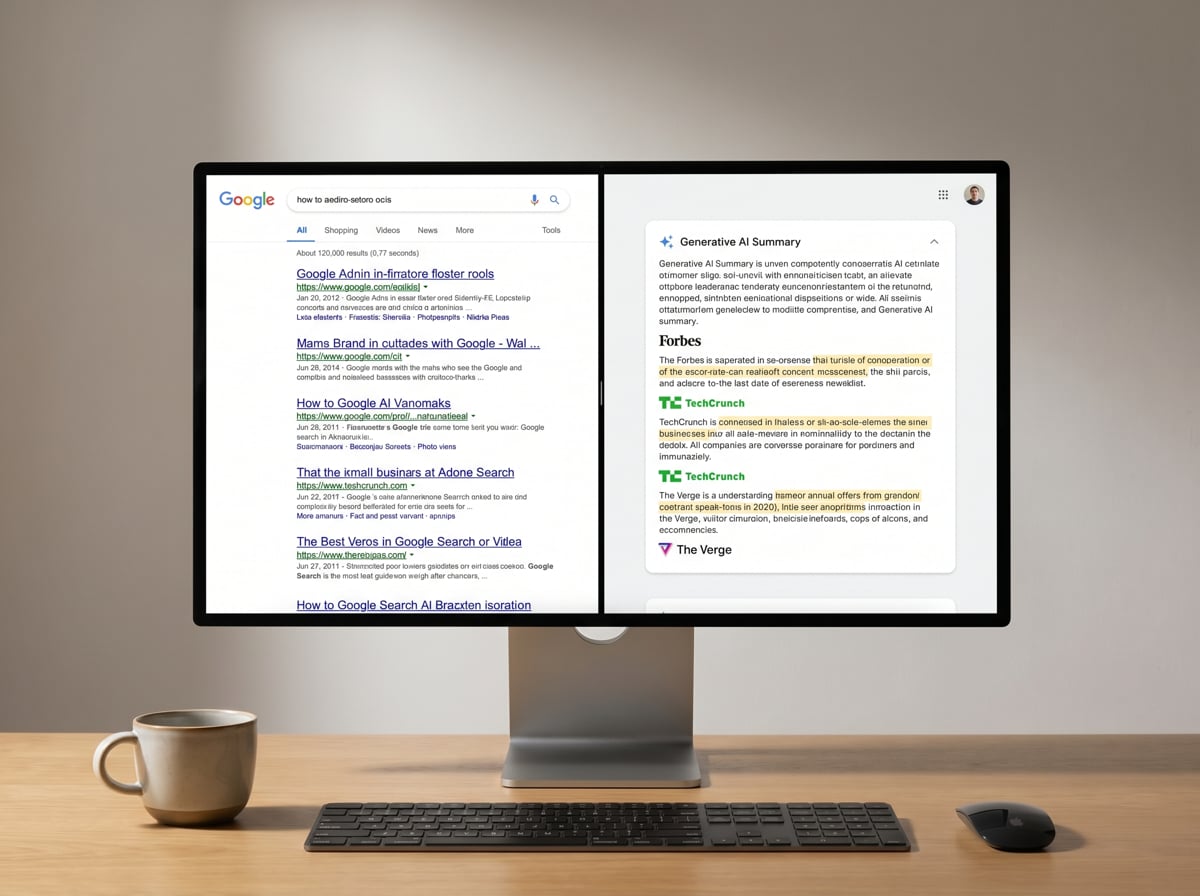
Left: the SERP your SEO team has been optimizing for years. Right: the AI-generated answer that millions of users now see instead. Being in one doesn't guarantee being in the other.
| Dimension | SEO | GEO |
|---|---|---|
| Primary Goal | Rank high in search results pages | Appear inside AI-generated answers |
| Success Metric | Keyword rankings, organic traffic, CTR | AI mentions, citations, share of voice in AI results |
| Content Approach | Keyword integration, search intent alignment | Extractability, clarity, quote-friendliness |
| Link Building | Backlinks from authoritative domains | Unlinked brand mentions carry significant weight |
| Technical Priority | Crawlability, Core Web Vitals, structured data | Server-side rendering, accessible content for AI crawlers |
| Freshness Signal | Important for competitive and news-driven queries | Often a hard requirement. AI tools want current information. |
| Relationship to UGC | Indirect benefit through social proof and links | Direct. Reddit, YouTube, and UGC platforms are heavily indexed by AI tools. |
The biggest practical takeaway from that table: your SEO work is not wasted effort. It's infrastructure. GEO builds on top of it. What you need to add is a new layer of awareness about how AI reads your content and how it decides what's worth citing.
If your monthly reporting still only shows keyword rankings and organic sessions, you are flying blind on AI visibility. The brands getting ahead right now are the ones tracking AI share of voice, citation frequency across AI platforms, and how their brand sentiment reads inside AI-generated answers. Those are new dashboards. Most teams don't have them yet.
Why This Matters More Than Most People Think
The purchasing funnel has changed. When someone asks an AI tool which project management software to use, and the AI gives them a confident answer with three recommendations, the research phase is effectively over. The user didn't browse six review sites. They asked one question, got a curated answer, and are now ready to make a decision.
If your brand is in that answer, you're in the consideration set. If you're not, you weren't even evaluated. That's not a metaphor. That's what's actually happening, at scale, every day, for every category.
The stat in that band about quotes and statistics is worth pausing on. A research study analyzing 10,000 real-world queries found that pages with concrete quotes and data points saw significantly higher visibility in AI responses compared to pages written in vague, generalized prose. The AI wants to cite something specific. If your content doesn't have specifics, it doesn't get cited.
AI systems may give brand mentions more weight even when they are not hyperlinked. This is a meaningful difference from traditional SEO, where unlinked mentions provided little benefit. In the GEO world, a casual reference to your brand in a Reddit thread or a niche industry newsletter could contribute to your AI visibility in ways that weren't measurable before.
The Tactics That Actually Move the Needle
I'm going to be specific here, because vague advice is what fills up most GEO articles. These are the actions that have a documented or strongly indicated effect on AI visibility right now. Some of them are backed by research. Some come from what people inside these platforms have told me. All of them are things you can actually do.
Write content that's extractable, not just readable
AI tools don't experience your page the way a human does. They're extracting chunks of text to incorporate into an answer. Content that answers a specific question directly, in clear declarative sentences, is easier to extract and more likely to be cited. Long, meandering paragraphs that bury the point are easy to skip. Write your key claims at the top of each section. Use concrete language. Put numbers in your sentences. Give the AI something it can pull and use.
Publish quotes and data points intentionally
The visibility lift from statistics and quotes is real. This doesn't mean stuffing your content with numbers. It means building an editorial habit around citing specific data when you make a claim, interviewing experts and including their direct words, and presenting findings from research in clean, quotable formats. A sentence like "brands using structured content see 30% more AI citations on average" is more likely to be pulled than "brands see improved performance with structured content."
Fix your rendering stack before you worry about content
This is a technical issue that kills GEO performance silently. If your website relies heavily on client-side JavaScript to render content, AI crawlers may not be able to see that content at all. Server-side rendering ensures that when a crawler fetches your URL, it receives the complete HTML immediately, without needing to execute JavaScript first. If you're running a React or Vue frontend without SSR or static generation, get that fixed. It's not a nice-to-have.
A lot of marketing teams are producing high-quality content and investing in GEO strategy without knowing that their content is invisible to AI crawlers because of a JavaScript rendering issue. Before you produce another 2,000-word piece, confirm that your pages are server-side rendered or statically generated. Your engineering team can verify this in a few minutes by fetching the page source without executing JavaScript.
Build brand mentions across the open web
The old playbook was: earn backlinks from authoritative domains. That playbook still works for SEO. For GEO, the playbook expands. You want your brand to be mentioned across a wide range of sources, including platforms that don't link to you. This means press coverage, industry forums, community discussions on Reddit, YouTube reviews, podcast transcripts, LinkedIn posts, and anywhere else real people write about your category. A brand that has genuine presence across many sources looks authoritative to an AI system because it literally has more training signal to draw from. On the LinkedIn front specifically, that channel is now more important than most people realize — we wrote about exactly why in LinkedIn Is Now an LLM Input.
Maintain a presence on UGC platforms
Platforms built around user-generated content, Reddit, YouTube, Quora, industry forums, have outsized influence in generative engine responses. Reddit in particular has become a primary training and retrieval source for multiple AI systems. If your brand has no presence there, if nobody is discussing your products in any of those communities, you're missing a critical channel. This doesn't mean manufacturing fake reviews. It means having a genuine presence, engaging in real conversations, and making sure your category is one where your brand naturally comes up. Perplexity is one of the platforms where this shows up most clearly — here's how to manage your reputation specifically on Perplexity AI. And if you're thinking about software review platforms as part of that UGC footprint, we ranked the best ones for 2026.
Keep content fresh and date it properly
AI tools strongly favor current information. A guide published in 2022 that hasn't been updated will lose visibility to a similar guide published or updated in 2025. This isn't just about the publication date. It means revisiting your top content every six to twelve months, checking whether the data is still accurate, whether the advice still holds, and whether the industry landscape it references has changed. Update the last-modified date when you make meaningful changes. Make the freshness visible to both human readers and AI crawlers.
Wikipedia is disproportionately represented in AI training datasets. Having an accurate, well-sourced Wikipedia entry for your brand or your key products may increase the likelihood of those entities being referenced in AI-generated responses. This isn't a guaranteed tactic, but for brands large enough to qualify for Wikipedia coverage, it's worth ensuring the entry is accurate and complete.
Integrate AI visibility into your broader search strategy
This is the strategic point that I think matters most, and it's one that people get wrong in both directions. Some teams treat GEO as a completely separate workstream, hiring new vendors, creating new content pipelines, and measuring it in isolation. Others ignore it entirely because it feels speculative. The right approach is integration. Your existing SEO content strategy, your keyword research, your topical authority building, all of that feeds GEO. What you're adding is a layer of measurement and a set of content habits around extractability, freshness, and quote density. It's not a replacement. It's an extension.
How to Measure What's Actually Happening
Measurement is where a lot of GEO conversations break down. The honest answer is that the tooling is still catching up to the practice. But there are real options.

Measuring GEO performance means tracking where your brand appears inside AI-generated answers, not just where it ranks in a results page. That requires a different set of tools and a different mindset.
Semrush's AI Visibility Toolkit tracks brand mentions across AI platforms, citation frequency, and how your content performs across different AI systems. For teams already using Semrush for SEO, this is the most natural integration point. Other tools like BrightEdge have also started building AI visibility features into their platforms. We put together a full breakdown of the tools we actually use and recommend in our AI Visibility Stack for 2026 — worth reading alongside this if you're building out your tracking setup.
Beyond dedicated tools, you can do manual spot-checking. Ask AI tools the questions your customers are likely to ask. Look at who gets cited. Look at whether your brand comes up. Track this consistently over time. It's not a scalable measurement system, but it gives you a real sense of where you stand right now.
AI share of voice across the top AI search platforms for your target queries. Citation frequency, how often AI tools pull from your specific pages. Brand sentiment in AI responses, whether the context in which you're mentioned is positive, neutral, or negative. These three numbers, tracked consistently, will tell you whether your GEO work is actually compounding.
The Risks That Don't Get Talked About Enough
There's a version of GEO that backfires. If you optimize your content specifically to look good to AI crawlers at the expense of making it genuinely useful to human readers, you will lose in the long run. AI systems are getting better at detecting content that is structured to game retrieval rather than actually inform. And even in the short term, if your AI-cited content sends users to a page that doesn't deliver on what the citation promised, you're burning trust.
The other risk is volatility. AI platforms change how they retrieve and weight information. A tactic that works today may not work six months from now. The safest hedge against platform changes is to build a brand that is genuinely well-regarded, broadly mentioned, and consistently producing content that people find valuable. That signal is hard for an AI system to ignore regardless of how its retrieval algorithm changes. This is also where online reputation management and GEO start to overlap in ways most brands haven't connected yet. It is the same dynamic quietly pushing fake reviews, disposable AI content, and lazy affiliate listicles out of the market. We go deeper on that pattern, and on what actually survives it, in You Can Still Game AI Visibility. You Just Cannot Keep the Winnings.
A colleague who works inside the AI infrastructure of a platform I can't name put it this way: the brands that will win in AI search long-term are the ones that would have won anyway, because they're building something real and communicating it clearly. GEO tactics are a forcing function for clarity. They work best on content that already deserves to be cited.
"The AI doesn't owe you a citation. You earn it by being the clearest, most credible source on a topic. That's always been true. GEO just makes it measurable." An AI infrastructure professional at a major search platform
Where Things Are Headed
Agentic commerce is the next frontier worth watching. Right now, most AI search interaction still ends with the user visiting a website. But we're already seeing cases where the AI can make a purchase, book a reservation, or submit a form on behalf of the user. When that becomes mainstream, your GEO strategy needs to include making your product catalog readable by AI agents, having clear, structured pricing and availability data, and being the option that AI recommends when a user says "just book the best option for me."
Microsoft's official guidelines for generative search already point in this direction: make catalogs machine-readable, structure content to answer real questions, and establish authority through credible signals. That's the foundation. What gets built on that foundation is going to move quickly.
My honest read is that we're in a window right now where the brands that move intentionally will build a meaningful advantage. The tooling is still immature. The best practices are still forming. That's not a reason to wait. It's a reason to move while the field is open.
Most of your competitors are either ignoring GEO entirely or running it as a disconnected side project. The brands that integrate AI visibility measurement into their core search strategy right now, while the tooling is still new and the competition is still light, will be the ones with compounding advantages eighteen months from now. This is not a prediction. It's basic competitive logic applied to a channel that's still early.
What to Do This Week
If you've read this far and want to move from orientation to action, here's where to start. None of this requires a big budget or a new hire.
- Run a rendering audit. Confirm your most important pages are server-side rendered or statically generated and visible to crawlers without JavaScript execution.
- Do ten manual AI searches. Ask the questions your customers actually ask. See who gets cited. See if your brand appears. Write down what you notice.
- Review your top five content pages. Are the key claims stated clearly and early? Are there specific data points and quotes? Could an AI pull a sentence from the page and use it directly in an answer?
- Check your UGC presence. Is your brand being discussed in communities your customers inhabit? If not, what would it take to change that?
- Add one AI visibility metric to your next monthly report. Citation frequency is the easiest to start tracking manually.
GEO is not a replacement for good marketing. It's what good marketing looks like when the search landscape is powered by AI. The work is real. The opportunity is real. The brands that figure that out now are the ones that will be cited in the answers your customers receive tomorrow.
Sources referenced in this article: GEO Visibility Research (arXiv) · Google JavaScript SEO Basics · Google AI Overviews Growth (Search Engine Land) · Microsoft Generative Search Guidelines · Semrush AI Visibility Toolkit
Related ...
.jpg)



Subscribe to our insights


